Next-Gen Agentic AI framework for building, orchestrating, and managing specialized LLM-driven AI Agents that can talk to customers, connect with data, call APIs, and automate business tasks in real time
The building blocks that make Agent M run your entire AI Agent setup


Agent M offers session management, memory for long conversations, secure access controls, and orchestration for seamless integration with external systems

Enable ready-to-use skills or create your own using our intuitive no-code studio.

Reduce hallucinations, manage data privacy with PII redaction, and control agent behavior with AI guardrails as safety barriers.

Deploy instantly across chat, voice, SMS/Text, email and 15+ digital platforms such as Facebook Messenger, WhatsApp, MS Teams, Telegram, web and more.

Run Agent M on ChatGPT or any other LLM of your choice.

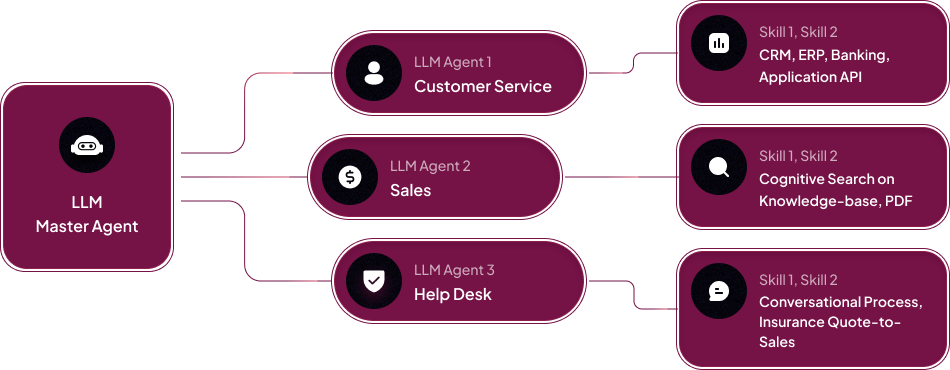
Seamlessly connect agents to CRM, ERP, or any custom application – no coding required.

Let your agents answer questions faster with AI-driven search. Just upload your internal data, knowledgebase or documents, and Agent M, powered by Cognitive Search, will take care.

Each agent handles a specific process – like answering FAQs, pulling data, or completing sales quotes. Agent M manages how these agents talk to each other and ensure smooth workflows.

Eliminate errors, keep private data secure, and test agent behavior in the Service Terminal for complete confidence before deployment.
The building blocks that make Agent M run your entire AI Agent setup
| Category | Agent M | Others |
|---|---|---|
| Conversation Handling | Excels at complex, multi-agent conversations | Struggles with multi-step logic |
| Contact Center AI | Optimized for real enterprise scenarios | General-purpose |
| Memory Module | Unlimited contextual recall | Limited to short-term sessions |
| Orchestration | Built-in multi-agent orchestration | Requires external tools |
| Latency | Responds in under 5 seconds | Takes 1–6 minutes |
| Guardrails & Hallucination Control | Has a native verification layer to reduce errors | No built-in control system |
| LLM Flexibility | Works with ChatGPT, Claude, Gemini and others | Usually locked to a single LLM |

Talk to your customers anywhere – web, app, or voice. Agent M powers smooth, human-like conversations across 15+ channels including WhatsApp, Messenger, and more.

Support your human agents with AI-driven suggestions, summaries, and AutoQA for SOPs' adherence.

Use Agent M to integrate ChatGPT (or any LLM) directly into your app. Connect it with your own data, workflows, and APIs without coding.
Agent M is an Agentic AI framework that enables enterprises to build, train, and deploy intelligent AI Agents for voice, chat, and agent assist. It enables multi-agent orchestration, and full control over AI Agent behavior.
No. Floatbot.AI provides a no-code interface. However, developers can extend functionality using APIs and pro-code options when needed.
You can build support agents, sales agents, help-desk agents, outbound agents, knowledge retrieval agents, and complex multi-step conversational agents — all within a single unified framework.
Yes. Agent M supports SOC 2, HIPAA, GDPR, PII masking, and data encryption. Sensitive data is never used to train models.
Yes. Floatbot.AI offers a service terminal for debugging, testing queries, validating responses, and inspecting real-time logs before deployment.
Yes. Agent M is LLM-agnostic. You can use Floatbot’s low-latency, proprietary LLM FloatGPT or integrate your preferred model such as GPT, Claude, Llama, or custom enterprise LLMs.