Co-browsing lets agents step into a customer’s screen & interact with it for visual assistance, accelerating problem-solving. No additional software or downloads needed.

Guiding a new customer through a multi-step digital application over the phone is slow and fraught with errors. A single missed field or upload error can delay account activation for days.
Customers get stuck on complex forms (e.g., loan applications, KYC updates). Without seeing which field is causing confusion, you can't prevent them from abandoning the process.
When a customer says, "I can't log in" or "the payment failed," your agent is left guessing. Is it a browser issue, a user error, or a genuine system bug? Diagnosis takes far too long.
Talking a customer through a sensitive task—like setting up a payee or updating security settings—without visual confirmation increases the risk of them making a costly mistake in the wrong section of the portal.
While on a service call, you can't visually guide a customer to explore a new credit card offer or a wealth management tool. The chance to add value and increase wallet share is lost.
Complex issues that can't be resolved visually over the phone often result in a branch visit. This drives up your operational costs and severely diminishes the customer's digital experience.
AI handles the volume. Agents handle the complexity - supported by co-browsing

A customer's journey begins with your Chat or Voice AI, handling common questions or services instantly.

For complex issues, the conversation is smoothly handed off to a live agent, with full context.

The agent can launch a co-browsing session to see the problem and guide the customer to a solution visually.
Shorten sales cycles, eliminate onboarding friction, resolve high-stakes issues on the first contact


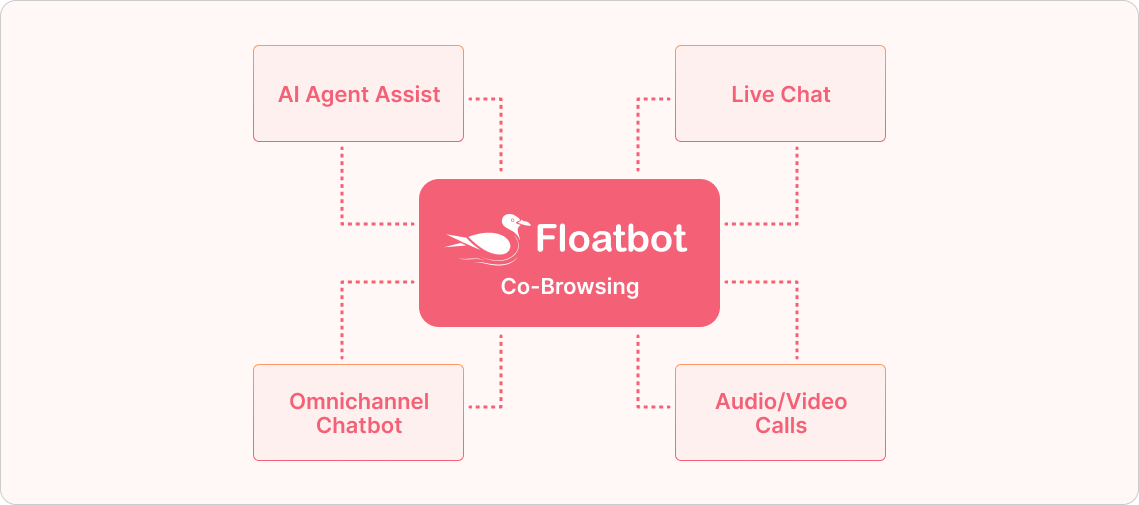
Guide customers visually by sharing their screen in real time. Resolve complex issues faster with no downloads required.

Add a human touch with built-in, high-quality audio and video calls for more personal interactions.

Highlight fields, buttons, or areas directly on the screen to remove confusion.

Speed up resolutions by sharing guides, forms, or images directly in the chat.

Protect customer privacy by automatically hiding sensitive information such as passwords or credit card details.

Capture co-browsing sessions and audio/video calls in one file for training and compliance.

Enable customers to sign agreements or contracts digitally during a live session.

Bring a specialist or supervisor into a session with one click to solve complex issues.

Reduce wait times by engaging website visitors in real time, improving satisfaction.

Improve agent efficiency with visitor alerts, organized chat tabs, and full history.

Manage customer interactions seamlessly across voice, chat, and SMS with a single AI platform that maintains context across all channels.

Break down language barriers with native support for over 150 languages and dialects, including Spanish, French, Arabic, and Hindi.

Empower your human agents with real-time AI-powered insights and suggested responses during live chat and voice conversations.

Connect your preferred AI tools for analytics, summarization, video analysis, and KYC verification through our flexible API.

Maintain full control by integrating your custom AI models.

Automatically identify and capture key information like names, dates, and locations from customer conversations.

Allow anyone on your team to create, deploy, and optimize conversational AI with our visual, drag-and-drop platform.

Leverage models pre-trained on thousands of hours of industry-specific data for immediate business relevance.













Yes. Cobrowsing masks sensitive fields like passwords and payment details. All sessions are encrypted and protected by access controls, ensuring data privacy and compliance with enterprise security standards.
No. Cobrowsing works directly in the browser—no downloads, plugins, or screen-sharing apps required. Customers simply click a support link to start a real-time assistance session.
Cobrowsing is ideal for insurance, banking, healthcare, e-commerce, and SaaS platforms. It helps agents guide customers through applications, claims, forms, onboarding steps, and complex transactions effortlessly.
Yes. Agents can draw, point, and highlight elements on the customer’s screen. This visual guidance makes it easier for users to follow instructions and complete tasks independently.
Cobrowsing eliminates confusion by showing—not telling—customers what to do. It reduces call duration, improves first-contact resolution, and increases satisfaction by resolving issues visually and collaboratively.
Yes. Cobrowsing integrates with popular CRMs, help desks, contact center platforms, and chat systems. Agents access customer history and assist without switching between applications.
Absolutely. Sales teams use cobrowsing to walk prospects through quotes, product demos, or application forms, reducing drop-offs and accelerating conversions. Onboarding becomes easier and more personalized.
Customers expect faster, personalized digital support. Cobrowsing reduces friction, increases agent efficiency, and delivers real-time visual assistance—essential for online services, complex workflows, and high-value transactions.